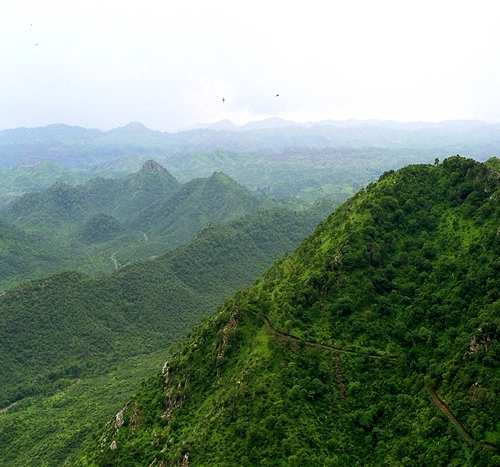
The Aravalli Range, one of the worlds most ancient mountain chains, stretching
across Gujarat, Rajasthan, Haryana, and Delhi, is currently at the centre of a
profound environmental and political controversy. The core of the issue lies in a
technical, yet far-reaching, decision by the Supreme Court of India in November
2025 to adopt a uniform definition for what legally constitutes an ;Aravalli Hill;.
This decision, aimed at streamlining regulation and curbing illegal mining, has
instead ignited widespread protests and fierce debate over whether
administrative clarity has been prioritised over essential ecological preservation.
The Aravalli Range is an ancient geological formation two billion years old, and
now it is facing an existential crisis. This is not merely an environmental
concern; it is a critical matter of public health, water security, and climate
resilience for millions across North India. Recent developments and a
controversial new legal definition have sparked widespread protests,
underscoring a desperate need for us all to act now.
The Aravallis are far more than just hills; they are a vital life-support system.
● A Natural Barrier: They act as an essential shield, physically blocking the
expansion of the Thar Desert eastwards into the fertile Indo-Gangetic
plains. Without them, dust storms would be more frequent and intense,
and desertification would accelerate rapidly.
● Water Security: The ranges unique rocky structure functions as a giant
sponge, capturing monsoon rainfall and recharging vital underground
aquifers that supply water to major cities like Delhi, Gurugram, and
Jaipur.
● Climate Air Quality: As the ;green lungs; for the Delhi-National Capital
Region (NCR), the Aravallis help regulate the local climate, moderate
temperatures, and improve air quality by trapping dust and pollutants.
● Biodiversity Hotspot: The hills provide a critical habitat and wildlife
corridor for leopards, hyenas, and numerous bird species, supporting a
rich biodiversity that is increasingly under threat.
The Governments Stance
For years, the absence of a single, consistent definition for the Aravallis across
different states had created regulatory loopholes, which allowed rampant illegal
mining to flourish. The Supreme Court, seeking to address this issue and acting
on recommendations from a committee led by the Ministry of Environment,
Forest and Climate Change, accepted a new, objective definition. Under this new
framework, an ;Aravalli Hill; is defined as any landform that rises 100 meters or
more above the local surrounding terrain, including its entire supporting slopes
and foothills. An ;Aravalli Range; is a cluster of two or more such hills within
500 meters of each other, ensuring the land between them is also protected.
The governments justification is rooted in the belief that this standardisation
brings transparency and objective map-verifiable boundaries, making
enforcement against illegal activity more effective. Officials argue that the
framework strengthens protection, not dilutes it, by mandating:
● A complete ban on all new mining leases until a comprehensive
Management Plan for Sustainable Mining is finalised by the Indian Council
of Forestry Research and Education.
● Explicit prohibition of mining in core ;inviolate; areas, such as wildlife
sanctuaries, tiger reserves, wetlands, and eco-sensitive zones, with
exceptions only for certain critical and strategic minerals.
● Strict regulation and monitoring of existing legal mines using advanced
surveillance technologies like drones and CCTVs.
The Centre has downplayed fears, stating that it is wrong to assume mining is
now permitted on all land below 100 metres and reiterating its commitment to
the Aravalli Green Wall initiative, a massive afforestation project aimed at
landscape restoration.
The Controversy
Despite the governments assurances, the new definition has triggered outrage
and a widespread ;Save Aravalli; campaign. The core controversy lies in the 100-
metre threshold itself. Environmental experts, supported by internal data from
the Forest Survey of India (FSI), contend that this criterion is arbitrary and
ecologically blind.
An internal FSI assessment revealed a startling fact: only about 8.7% of the total
mapped Aravalli hill features meet the 100-metre elevation benchmark. Critics
argue that the vast majority of the range is comprised of lower, scrub-covered
ridges and hillocks (often only 10-30 metres high) that are ecologically critical
but would now fall outside the legal definition of an ;Aravalli Hill;.
The potential consequences are severe:
● Desertification Risk: These lower ridges act as the primary natural barrier
against sand and dust storms from the Thar Desert. Breaching them could
accelerate desertification towards Delhi-NCR.
● Water Crisis: The foothills and slopes are crucial for rainwater infiltration
and recharging groundwater aquifers for millions. Opening these areas to
construction could worsen the already severe water scarcity.
● Air Pollution: The Aravallis are often called the ;green lungs; of North
India; their removal would likely exacerbate air pollution in the NCR
region.
● Fragmentation: By focusing only on high peaks and closely grouped hills,
the definition ignores the essential landscape-level continuity of the
range, fragmenting wildlife corridors and habitats.
Activists like Neelam Ahluwalia of the People for Aravallis group and
environmentalist Vikrant Tongad argue that mountain systems should be
defined by their functional ecological role, not an arbitrary height. They point out
that key scientific inputs were allegedly sidelined during the committee process
that recommended the 100-metre rule.
A Call to Action
The public response has been immediate and sustained. Peaceful protests, silent
marches, and social media campaigns have erupted across Gurugram, Udaipur,
Jaipur, and Delhi. Citizens, farmers, and lawyers have united under banners like
the Aravalli Bachao Citizens Movement to demand that the government revise
the definition to be based on comprehensive scientific criteria that include
geology, ecology, and wildlife connectivity.
The Save Aravalli movement represents a potent call for environmental
accountability and intergenerational equity. The immediate freeze on new
mining leases offers a temporary reprieve, but activists are pushing for
permanent, legally binding protection that encompasses the entire geological
span of the range, regardless of local elevation.
Ultimately, the debate is a microcosm of the global tension between economic
development and ecological preservation. The Aravallis are a finite resource, a
billion-year-old shield that cannot be restored once destroyed. The ongoing
protests underscore a clear message: the long-term survival of North Indias
environment and public health must take precedence over short-term
commercial interests.