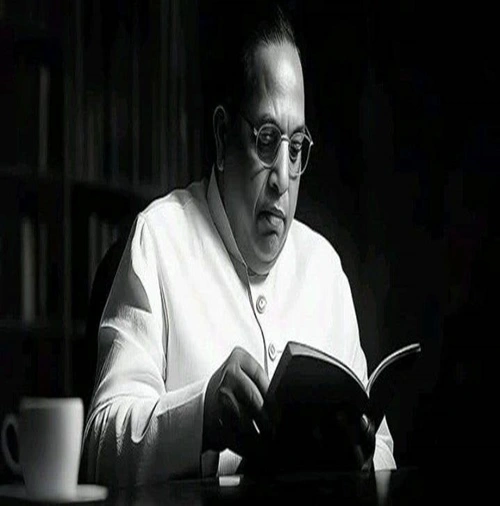
In school, it was important to remember Ambedkar for a one-mark question. Who would
want to remember anything more about a man who always had a book in his hands and wore
spectacles? All books were seen as textbooks that needed studying; this was a repulsion to us
as children. We just wanted to know the answer and did not really worry about how we got
there. The undercurrent was always to score the highest competitive marks, so reproducing
data was key. The more data there was to memorise, the more pages there were to read;
hence, anyone projected with books was a natural repulsion. However, Ambedkar saw
education beyond securing the highest marks; it was a tool to understand our external and
internal realities better and thus place our contribution in building the community.
In a time when education was significantly reserved for Savarnas, Ambedkar opened the door
for a diverse classroom. He paved the way for meaningful competition—not only for securing
marks but for cultivating deep friendships across castes, accommodating diversity,
understanding differences, and, most importantly, promoting gender equality. Today,
education as a fundamental right has resulted in the Right to Education Act, 2009. The
number of girls admitted to schools and universities is far higher than what it was even 25
years ago.
Ambedkar himself was an exemplary student who excelled in a hostile learning environment
that was nowhere near the ideals he later propagated. He was made to sit on the floor, away
from his Savarna classmates, and had a separate glass to drink water from, even when he
entered university. After being the only ‘untouchable’ student at Elphinstone High School in
Bombay, he went on to become the first Indian to pursue a doctorate in Economics overseas.
He returned to India as a promising lawyer and wasted no time in creating a long-lasting
legacy that is impossible to overlook even today.
To Ambedkar, the individual was someone who deserved dignity and respect, regardless of
caste, creed, gender, age, religion, or ideology. This is perhaps the magnetic field that drew
any intentional and comprehensively driven change into reality. As much as Ambedkar is
remembered for his work with the marginalised, he was also a cornerstone for the workforce.
Carrying the baton of employee wellbeing, Ambedkar gave a competitive edge to Indian
labour laws. Paid leave, employee benefits, and mandatory weekly days off were some of the
several employment dimensions that Ambedkar proved were possible, and which continue to
be in effect today.
Propagating gender equality, Ambedkar was a strong proponent of the rights and dignity of
women in the workforce. Equal pay, maternity leave, and compensation were vehemently
upheld by him. He advocated for widow remarriage as a step towards self-determination and
gender equality; he also propagated equal property rights for women using the same logic.
Ambedkar believed that a strong social anchor would cultivate a robust community and
nation—for that, meaningful societal liberation was central to his mission. Needless to say,
alarm bells rang loudly for the small groups who benefited from a society based on the caste
system.
Perhaps, could this be the reason why Ambedkar is reduced to a one-mark question? Is it still
the right time to think of Ambedkar? A godsend for some and a troublemaker for others,
Ambedkar’s personality is an inconvenient role model for anyone with a prejudiced and
underprepared approach to development. While some build statues of Ambedkar, others
intentionally behead them, which is why his statues are often secured by fences or metal
enclosures, especially in Savarna localities. Even after his death, Ambedkar’s work remains a
saving grace for thousands of people from the marginalised and depressed sections of society.
This is why today, and every day, is the right time to think of Ambedkar.
So, what is the legacy that Ambedkar leaves for those who see him as a role model, those
who embody his ideals, and those who never lose an opportunity to behead his statues?
Unfortunately, no textbook answer can help. Those who try to decapitate his statues or his
ideals feel eternally threatened despite their generational entitlements, while those who see
him as a role model either ritualise his memory or find their own route to self-determination.
Today, you can find Ambedkar almost everywhere—everyone wants a piece of him, even
those he challenged (and won).
However, Ambedkar significantly subscribed to the legacy of Gautam Buddha, who led one
of the earliest revolutions against caste oppression. Some statues of Buddha dating back over
2,000 years have been discovered buried intact, decapitated, or thoroughly destroyed. It
seems as though neither Buddha nor Ambedkar minded losing their heads for their beliefs.
Both have been the subject of intense scrutiny, critique, and even violence after their
respective deaths, spanning 2,000 years of history in our subcontinent. Ambedkar did not
reinvent the wheel; he found a way for the wheel to serve everyone well. Like him, there
were many before and during his time who sought to leave the world better than how they
found it.
Ambedkar, born into a Dalit household, experienced social, religious, cultural, economic, and
political discrimination at all stages of his life. This led Ambedkar to empathise with those
who experienced similar discrimination during his time, and even beyond it. He kept his head
on his shoulders and did all he could to ensure nobody was left out. He died in his sleep after
a prolonged illness, survived by his family and leaving behind a wealth of unpublished
writings.
Ambedkar remembers us today, even without knowing our names or backgrounds. He
remembers the working woman and man, the child who needs care and education, the widow,
the daughter who is heir to a fair share of her parents’ inheritance, and the child who is the
first in their generation to receive an education in an unequal society. Ambedkar opened the
door to enriching the mainstream with a diversity that nurtures a united, compassionate, and
liberated country. Whether today is the right time to think of Ambedkar or not, Ambedkar has
always thought, and continues to think, about us every day.
Happy Birthday Bhim Rao Ambedkar. Jai Bhim!