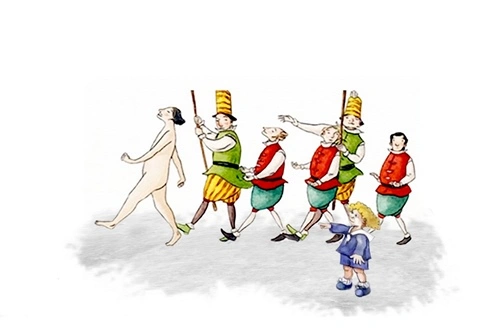
The vain emperor walks in procession without clothes. Fearing to appear
incompetent and unfit, the emperor and his court pretend to see the nonexistent
clothes. The swindler corporations keep selling the most exquisite nonexistent
clothes and make their profit in broad daylight. The Hans Christian Andersen’s
1837 fable, The Emperor Has No Clothes, comes true today more than ever
before. We know we're exposed—our data harvested, our privacy dissolved, our
intimate moments archived and monetised—yet we cannot stop the procession.
The modern emperor is trapped in the performance, unable to stop because the
algorithm demands continuation. Who will break the collective delusion? Where
is the petite whistle-blower child?
When Michel Foucault examined Jeremy Bentham's panopticon in Discipline and
Punish: The Birth of the Prison (1975), he described a prison designed around a
central watchtower from which guards could observe inmates without being
seen themselves. The genius of this architecture was not the watching itself, but
the uncertainty it created. Prisoners, never knowing when they were observed,
began to police and regulate their own behaviour. The watchtower became
internalised. State-surveillance transformed into self-surveillance. What
Foucault could not have fully anticipated was how thoroughly we would
dismantle the watchtower and rebuild it in our own pockets, tie it on our very
hands, and plant it in our personal computers.
Surveillance has always been an architecture of authoritarian hierarchy—a tool
of power over the powerless. In prisons, the architecture spoke clearly—stone
walls and iron bars declared who watched and who was watched.
In the
totalitarian regimes of the twentieth century, this model expanded beyond
prison walls. George Orwell's 1984 imagined telescreens that broadcast
propaganda while simultaneously recording citizens, the two-way mirrors of a
surveillance state. East Germany's Stasi employed nearly two lakh informants
creating a society where neighbours watched neighbours and kept the
totalitarian regimes informed; trust dissolved into suspicion. The idea of
surveillance spread like cancer into every cell and fabric of everyday lives.
During the Civil Rights Movement in America, J. Edgar Hoover's FBI deployed
secret agencies to surveil, infiltrate, and disrupt activists. Martin Luther King Jr.
was monitored, his phone tapped, his private life weaponised against him.
Surveillance was the state's dagger, cutting away at dissent. The message was
clear: to challenge power is to invite the gaze, and the gaze is unkind.
This was surveillance as domination. The cameras pointed downward. The
microphones belonged to those in uniform or undercover. The files were kept in
locked rooms. And the people being watched knew it, feared it, and when
possible resisted it.
The Postmodern Shift
Something shifted in the late twentieth and early twenty-first centuries. The
architecture remained, but its appearance changed. Shoshana Zuboff, in The Age
of Surveillance Capitalism (2019), describes how corporations discovered that
human experience could be harvested as raw material, converted into
behavioural data, and sold to the highest bidder. Google, Facebook,
Amazon—these platforms offered services that felt free, even liberating. We
signed terms of service, written in fine print, which we never ‘read’ and agreed.
The cameras turned around. We began pointing them at ourselves.
Instagram asks us to curate our lives into aesthetic moments. TikTok rewards us
for performing our personalities. Snapchat's maps let friends see exactly where
we are, exactly when. We check in at restaurants. We tag our locations. We go
Live. We share not just what we see but what we eat, what we wear, whom we
love, where we hurt. Going even further, we don't just live; we perform living to
be seen attractive and fitted in. Everyone is performing, everyone is watching,
everyone simultaneously is surveilled and surveiller. The watchtower is no
longer hidden. It is in our hands. We bought it ourselves—the iPhone, the Ring
doorbell, the Alexa that listens even when we forget it's there. We didn't just
accept surveillance; we desire it, pay for it, and update it when new versions
arrive.
In the influencer economy, we have become our own censor board and prison
guards. We have internalised the gaze so completely that we preemptively edit
ourselves before posting, anticipating how we'll be perceived, calculating
engagement, chasing metrics that quantify our social worth. We make our lives
surveillable. David Lyon, a scholar of surveillance studies, coined the term
‘surveillance culture’ to describe a society where being watched is not an
imposition but an expectation, even a pleasure. We don't just tolerate
surveillance; we have gamified it. Prisons disciplined individuals by forcing them
inside a cell and making them visible. We have automated visibility; we queue up
to enter in; and algorithms keep guard over us.
The cruelest trick of contemporary surveillance is that it feels like freedom. We
choose our apps, we decide what to share, and we can delete our accounts (in
theory, though the data often persists). This veneer of choice hides the
intimidation beneath. In the words of Foucault, recognizing how power operates
is the first step toward resistance; here we have the illusion of choice, which
makes resistance harder. Perhaps our way forward lies in making surveillance
visible again. We must wakeup the whistle-blower child within us who shouts,
‘the emperor has no clothes.’