I shall start this article with a personal anecdote. Two months ago, at a wedding, a woman
unexpectedly started talking to me about how authorities had shown up at her relatives’
house at 3 in the morning, asking if they knew the accused in the recent blast at the capital.
They did not. In hindsight they remembered talking to their son, who studies in Delhi, to
make sure he is safe. In another relevant episode, an adolescent boy talked to his father’s
business partner on the phone, saying ‘Aa samaan wott’, (Kashmiri for ‘yes, the goods have
arrived’). Later that day, a man in ordinary clothes with a team of people wearing black
uniforms demanded answers from the boy, where are the goods? What have you been up
to? The kid innocently (and nonchalantly) pointed to the storehouse referring to the box of
chocolates and other packaged foods for his father’s provision store. Before he could open
the door to give them a tour, he found himself being beaten to reveal some ‘coded’
information. He had no idea what, how and from where to get the answers needed there.
His father was told afterwards that they had heard about some goods being delivered from
one party to another on the call. It was being tracked by a bug planted on his sister’s Wi-Fi
network, which he often used. The story was narrated to me by the sister.
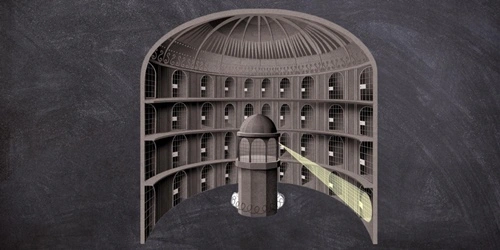
These were two out of billions of examples of panopticism and hyper-surveillance, in
contemporary times. Based on ‘Panopticon’ (Bentham, 1787) – a perfect surveillance
structure to monitor prison inmates wherein the tower guard can see into every inmate’s
cell, with tinted windows and lights so bright, that the inmates cannot observe the guard
back. This ensures the inmates internalise discipline by self-regulation. A social
psychological experiment revealed that subjects tend to display more acceptable behaviour
when they know they are being monitored, constantly. In fact the conclusion still stands, if
the observation is passive, like that of a CCTV camera, or more surprisingly, a simple
picture of a pair of eyes. This is known as the Hawthorne Effect in psychology. Panopticism,
according to Foucault (1975), refers to a system wherein “the individual is constantly
located, examined and distributed among the living beings, the sick and the dead—all this
constitutes a compact model of a disciplinary mechanism”.
The disciplinary mechanism that Foucault mentions, in this case, is an aggregation of state-
led strategies, which are required to constrain seditious activities, and counter insurgency.
However, what this mechanism inevitably ends up doing is violating privacy and to a larger
extent, freedom of speech of the general population. It does so by creating a discrepancy of
power. The observer holds power over the one being observed. The invisible is invincible.
This concealed, omnipresent observer is the source of perpetual fear and consequently,
paranoia. He is the man in the tower. Internalisation of fear manifests into psychosomatic
disorders, anxiety disorders, PTSD and psychosis. 10 years ago, a journalist was reported to
be on the verge of psychosis, as a result of prolonged paranoia. In Orwell’s 1984, the people
of Oceania live in a ‘virtual prison’, where the political system is inherently intrusive,
monitoring every household conversation, thereby dangerously gaining access to the
psyche of its people. This panoptic surveillance ingeniously used by Orwell 76 years ago, is
relevant to modern times. Likewise, Kafka uses this concept in The Trial, where the rigid,
bureaucratic structure is designed to be invasive; closely monitoring intersystem and
intrasystem individuals together with their social connections. The pervasive system acts
as the dominant, omnipresent third eye. This all-watching, incomprehensible and faceless
observer, gives rise to a dystopian context, wherein, the individual is destined to be
crushed.
What effect does a society on the brink of dystopia have on people’s behaviour, and mental
state? Kashmiri people struggle with disoriented psychological health, and a fractured
society. Knowing not whom to trust, breaks the collective power of the society. Sadly,
people are gradually habituated to putting on a mask, carefully concealing their actual
opinions, and suppressing their emotions. Panopticon has been extensively used in
geopolitical areas of conflict to curb certain threatening elements. The important question
that arises is how much freedom does a commoner have to forgo, in order for ‘The Party’ to
fight crime and insurgency in the state.
Shahnaz Bashir, in his painfully crafted, award-winning book Scattered Souls (2016), uses
the metaphor of the bullet lodged in Ameen’s spine for a panopticon: unwanted and
interfering, however ever-present. Additionally, he uses the same metaphor for its
consequences. The unification of fear as a part of the body. This constant fear due to the
panopticon (bullet) is a death warrant for the body, wherein it slowly but surely will kill its
host.
Whenever asked about the concerns of violating human rights due to obtrusive
surveillance, authorities have said that national security comes above everything else.
Many have argued that the methods are unobtrusive. The unnoticeable nature of the
panopticon does not entail its absence. Rather, its inconspicuous nature creates a sense of
further unease, because we are unaware when and how we are being monitored.
Critics insist that the panopticon nature of surveillance ‘more often captures the right-
moralled prisoners’, insinuating the blameless commoners, purposelessly caught like I
mentioned in the beginning. It manufactures more criminals than it captures; the actual
criminals become experts at escaping the ‘old-fashioned’ monitoring system. Civilian
security is as important as national security.
Ironically, as I’m writing this article or I talk about the contents of this article over the
phone to my friend, there is a persistent, subconscious fear in the back of my head. The
continuous fear that every movement is being observed, and recorded. Unfortunately, the
consequences of the present extend ambiguously into the future.