We are in the midst of a lot of things: an Epic Fury—the Iran war which has
eclipsed and jeopardised lives everywhere; remembering Ambedkar as we
celebrate his birth; the grand completion of Kochi Muziris Biennale—the
greatest art encounter in Asia; other disturbing things like the Epstein files, the
Transgender Persons Bill 2026, and of course, the holy season of the Ramadan,
Good Friday and Easter. We may categorise these to political, social, cultural,
religious, and so on; but look again, there is something that goes through all
these without escape—our bodies.
There is a telling German word, primarily rooted in the work of existential
philosopher, Martin Heidegger, Dasein, literally meaning ‘being there’ (da =
there, sein = to be). Dasein describes the unique, lived experience of the human
condition; an entity that is acutely aware of its own existence. It captures the
feeling of being thrown into a world, a culture, and a time we didn't choose, yet
still carrying the burden and the freedom to navigate it, make choices, and
ultimately confront our own mortality. Dasein is the brutal physicality of our
being—a body thrown under.
The idea of ‘the body as archive’ asks us to think of flesh, blood, and nerve as a
site where history is inscribed and held. Scholars, writers, and activists across
traditions have come to understand that the experiences of war, caste
discrimination, class violence, and trauma do not simply pass through us; they
leave deposits; they become us. The body, as Diana Taylor has argued, holds
memory in ways that text and institutions cannot; the body's memory is living,
transmitted person to person, and generation to generation.
When war with its human brutalities enters the bodies, be it of soldiers, civilians,
refugees, and survivors, they carry the war in their nervous systems long after
the bullets stop. I have known people who lived though the deprivations caused
by World War II. Even amidst plenty they hide a couple of morsels of bread,
thinking, what if the next meal does not arrive. They startle and flinch at a
sudden sound; it is not dramatic exaggeration, but the body's memory of a time
when sounds meant danger. Civilians who survived the Partition of India, the
genocide in Rwanda, the carpet bombing of Vietnamese villages, all carry the war
in their bodies in ways they often cannot articulate. Survivors of Partition have
reported that certain smells, burning, particular spices, the dampness of
particular seasons, still bring on waves of panic or grief that cannot be connected
to any clear thought. The body has kept its own record.
Bessel van der Kolk, one of the foremost researchers on trauma, makes a
devastating observation in his landmark book, The Body Keeps the Score,
"Trauma is not stored as a narrative, with a beginning, middle, and end. It is
stored as sensation. Van der Kolk goes on to describe Tom, a Vietnam War
veteran who could no longer connect with his family. Tom himself said that after
his experience, it had become “truly impossible for him to go home again in any
meaningful way.”
If war writes itself on the body through shock and terror, caste writes itself more
slowly; through repetition, through a thousand daily interactions that teach a
person what their body is worth, what it is permitted to touch, where it is
allowed to stand. Dr BR Ambedkar, the great Dalit advocate, understood that
caste was not merely a social custom. It was a system of control of the body with
a logic of purity and pollution inscribed on the skin, colour, and birth. Caste
choreographs the body: who bows to whom, whose feet are touched and whose
are not, whose body must move out of the way. The Dalit writer and activist
Sharankumar Limbale, in Towards an Aesthetic of Dalit Literature, argues that
Dalit writing must be understood as testimony that speaks from the wounded
body; it is written from within a body that has been systematically told it is less
than human.
In the Mari Selvaraj film, Bison, the protagonist’s involuntary flinch in the
presence of upper-caste aggression is a profound display of embodied memory.
The body, conditioned by generations of caste violence, does not just brace
against the immediate threat—it braces against history itself.
This is not limited to India. Across the world, wherever racial or caste
hierarchies have existed, they have operated through the body. American
slavery, apartheid South Africa, colonial hierarchies in Africa, Asia, and
elsewhere, all worked by classifying bodies, marking them as inferior, controlling
their movement, their labour, and their reproduction.
The bodies of people who perform physical labour; in mines, in fields, in
factories, in domestic spaces, carry the marks of that labour in ways that are
hard to conceal. Bent spines from years of bending and in the works of Sebastião
Salgado’s iconic photographs of the workers with bend over bodies in Serra
Pelada gold mine in Brazil serve as one of the most profound visual
documentation of the body as archive. They are the body keeping its account of
what capitalism extracted from it.
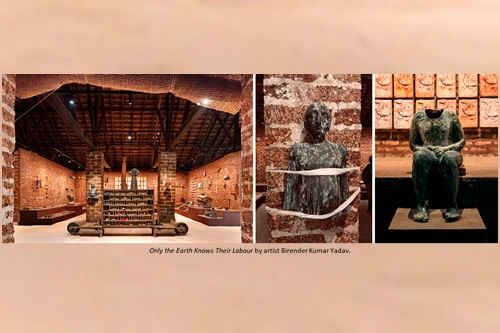
At the Kochi Muziris Biennale I saw an installation titled Only the Earth Knows
Their Labour by artist Birender Kumar Yadav. The work invites viewers into a
space that feels like entering a brick kiln; and reflects on the lives of brick kiln
workers. The workers themselves are absent, yet their presence lingers
everywhere. In an interview, Yadav reflects: when someone performs intense
physical labour over long periods, the body begins to adapt, movements become
repetitive, and the person almost merges with the tools they use. The half-figure
tied to a wall captures what remains after burning—in brick kilns, workers
endure such extreme heat that their bodies, too, feel burned or melted by the
process.
Joining the global protest…
We Must Evolve To End Wars
The essence of KM Gaffoor’s Malayalam poem Yudham (War) could be translated
this way: over small things, we lose our patience and cool, we grow in anger and
revenge. When the food had a little less salt, we struck the table in frustration,
and pushed the plate away violently. When someone gave a harsh feedback we
banged the door so hard. When a glass slipped and shattered, we raised our
hands in punishment. Over small things—a meal, a feedback, a mistake—we
became storms. ‘This is us.’
And then we, seeing the horrors of war, ask, what is war? Why is there war? KM
Gaffoor answers it plainly: ‘war is simply us, made larger.’ War is the ultimate
regression; but it is not something that begins out there, between nations and
armies and strangers on maps. War is something that begins in here—in the
kitchen, at the dinner table, in the spaces between people who are supposed to
live with each other.
War is not a disease, but the symptom of weak leadership. A weak leader cannot
hold power through competence, so they reach for spectacle; war is the oldest
spectacle there is. In modern world, strong countries do not go to war, but strong
countries with weak leaders do. When a strong country ruled by a strong leader,
they assume world leadership, they lead the world to the next phase of human
evolution; weak leaders take us back to the dark ages.
Japan made one of the most remarkable political decisions of the 20th century.
Following the devastation of World War II, Japan adopted a new constitution in
1947. Article 9 of this document famously states that the Japanese people
"forever renounce war as a sovereign right of the nation and the threat or use of
force as means of settling international disputes." The United States, Russia,
China, the United Kingdom, France—all permanent members of the UN Security
Council, all nominally committed to international peace—all maintain the
explicit right to wage war and have the arsenals to prove it. Costa Rica, following
the Japan way, in 1948 abolished its military entirely and enshrined no army-no
war policy in its constitution. Today, Costa Rica remains one of the most stable,
prosperous, and ecologically advanced nations in its region. Who else dares?