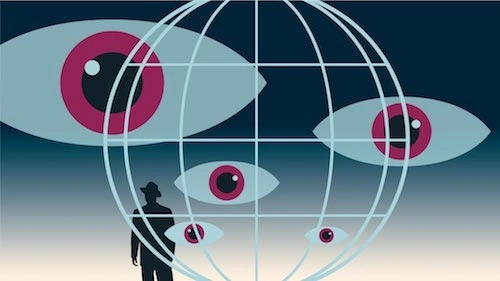
When Laura Mulvey first articulated the concept of Male Gaze and the power structure
it inhabits inside, in 1975, she wasn't just writing a critique of Hollywood, she was
performing a forensic audit of how power operates through a lens. She suggested that
the camera is never neutral. Instead, it adopts the perspective of a heterosexual male,
forcing everyone in the audience, regardless of their own gender, to see the world, and
specifically women, through that singular, often hungry perspective. After years of
watching the light hit the screen, I’ve seen this gaze evolve from the black-and-white
morality of early Indian cinema to the hyper-masculine, alpha blockbusters of our
current era. To understand the sociopolitical tensions in India today, we have to
understand how we’ve been taught to look.
The Three-Way Mirror
The male gaze functions through a triptych of looks that are almost impossible to escape
once you know they are there. First, there is the look of the camera as it records the
scene, second, the look of the male characters within the film’s world; and third, the
look of the spectator.
In this structural trap, the woman is rarely allowed to be a person with a complex
interior life. Instead, she is reduced to what we call to-be-looked-at-ness. She is the
landscape, the prize, or the problem the hero must solve. For the male viewer, this
creates a narcissistic identification, he sees a surrogate of himself on screen who is
active, dominant, and in control. For the female viewer, the experience is more
alienating. She is coerced into looking at herself through the eyes of the man who wants
to possess her. She becomes both the spectator and the spectacle.
In the Indian context, this gaze has historically been expressed through a stark, almost
religious binary: the Madonna and the Whore. For decades, the ideal Indian woman
was the Sati-Savitri, the self-sacrificing mother or wife who served as a metaphor for the
nation’s purity and honour. But as our cinema modernised, the gaze didn't disappear;
it just changed its clothes.
Think about the item number from a storytelling perspective, these sequences are
usually entirely redundant. The plot stops, the narrative takes a breath, and for five
minutes, the camera performs a visual dissection of the female body. We don’t see a
human being; we see a series of fragments, a midriff, a pair of lips, the curve of a hip.
This fragmentation is a psychological tactic. By breaking a woman down into parts,
the gaze strips her of her humanity. It turns her into a fetishized object. When you see
only a part of a person, you don’t have to reckon with their soul. This leads to what
authors, philosophers, and writers far more intelligent than I call the monster
problem of representation. When women are constantly presented with these
fragmented, airbrushed, and impossible versions of femininity, they begin to view their
own bodies from the outside. They develop an internal surveyor that never sleeps.
This creates a sense of self that feels distorted and inadequate, a monster that can
never live up to the cinematic image designed for male consumption.
From the Screen to the Street
The danger of this gaze is that it doesn’t stay behind the velvet curtains of the theatre. It
spills out into the streets of our cities, providing a cultural script for how we treat one
another. In India today, we are seeing a massive resurgence of the hyper-masculine
hero. These characters are often aggressive and possessive, defining their manhood
through their ability to claim women.
This cinematic regression, which trivializes a woman’s no into a playful yes, does
more than just tell a bad story; it actively justifies a sociopolitical culture that views
female independence as a threat. By consistently casting men as the active surveyors,
our screens grant them an unearned sense of ownership over public life, effectively
rebranding street harassment as Eve-teasing and turning shared spaces into a purely
male domain.
Also, the historical burden of treating the female body as a repository for national
honour has transformed the male gaze into a powerful tool for social surveillance. In
this framework, a woman’s attire or mobility is no longer a personal choice but a public
reflection of family or state status. Ultimately, the gaze achieves its final victory within
the mind itself. Having been raised on this visual diet, many women find themselves
performing for an invisible audience even when alone, proving that the surveyor is no
longer just on the screen—he has been internalized by the surveyed.
The Challenge of a New Vision
Could a female gaze be a simple fix? We cannot just put a woman behind the camera
and expect the gaze to change if she is using the same visual vocabulary. The same
lighting, the same editing, the same tropes that has been built over a century of
patriarchy.
A true shift requires interiority. It requires a camera that is more interested in what a
woman is feeling than how she is lit. It requires stories where women are allowed to be
messy, unlikable, and entirely independent of their relationship to the hero. In India’s
growing independent film scene, we are seeing the first real flickers of this. Films that
refuse to fragment the body and instead insist on the wholeness of the human
experience.
The male gaze is a lens that has coloured the Indian soul for generations. It has dictated
our desires, our laws, and our deepest insecurities. As we move further into this decade,
the stakes have never been higher. We are at a crossroads where we must decide if we
will continue to be a society of surveyors and objects, or if we will have the courage to
dismantle the camera entirely.
The goal isn't just to change the images on the screen, but to change the way we see the
person standing in front of us. We need to move toward a visual language that
recognizes humanity over utility. Only then can we move past the monster in the
mirror and see the reality of the Indian woman not as a symbol, not as a prize, but as a
person. The first step toward freedom is simply realising that the lens is there. Once you
see the gaze, you can never unsee it, and once we unsee it, we can finally begin to look
away.