We have run the first quarter of the third millennium. It may be more honest to say
that the first quarter of this millennium has happened to us—in this relatively short
period we have changed and aged beyond recognition, we have advanced more than
the last two millennia put together. The change is so accelerating that nothing has
remained the same, except humanity’s eternal desire to remain young. There has
been no time in recorded history when change was so rapid and unsettling.
Change
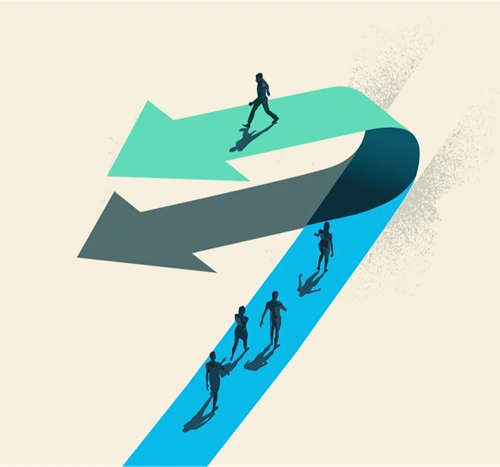
itself has undergone uprising and rebellion. Change is not happening in its given
swiftness and stride—it no more has a beginning, middle, and end. Things no more
change; they take a total shift—everything at once—every now and then we find
ourselves in a strange new world. The generation gap is growing with evolving
neocultural norms and lifestyle changes; generation spans have shrunk to 5–10
years. Some of us feel far left behind in the passage of mere twenty-five years.
Multiple generations and worlds are at play simultaneously. Technologies, lifestyles,
values, and even the lingo are changing at an accelerating speed. Change, as we had
known it, is something of the past—get used to total shifts, and parallel worlds.
The World Is Feeling Fast, Loose, and Unsettled: The industrial era is collapsing
and the Internet of Things, the digital revolution, and artificial intelligence are
replacing it. This is the biggest shift since electricity. We are moving from labour and
toil-driven times to intelligence-driven times; yes, a quick-witted intelligence, a
smart new world. Intelligence is no one’s monopoly; thus the hierarchies and
pyramids are falling apart. Millennials exhibit a preference for a more lateral and
collaborative approach to thinking and operations, moving away from the rigid,
hierarchical vertical thinking models of previous generations.
Anchors of Society No Longer Anchor Anything: Institutions and establishments
cannot keep up with the velocity. Governments, schools, families, and regulatory
systems still operate on timelines and logic of the second millennium; they still
follow hierarchical knowledge transfer, decision-making, and governance. Natives of
the third millennium feel disoriented—I would say reoriented—because the
customary anchors of society no longer anchor anything. Parents, teachers,
traditional leaders, and all sorts of folks have a fear of losing it all. Read it along with
the recent instances of several world leaders facing generational pressure and low
approval ratings and thus seen in media and in political commentary making erratic
or frantically stupid comments and decisions, like Internet blackouts, control, and
violent crackdowns. Parents and teachers too do the same in their jurisdiction to
frantically hold on to the control that they have exercised all along.
Attention Is the New Currency: In today’s information-saturated world, human
focus and awareness have become incredibly valuable resources, like or more than
money for brands, creators, and individuals. As platforms compete fiercely for our
limited mental bandwidth, having the ability to capture and hold it is the key to
success, connection, and revenue. Creators and influencers adapt to new algorithmic
designs, provide dopamine loops, to keep users hooked. Worse still, they exploit the
negativity bias of users seeking out and getting trapped in cycles of alarming and
distressing headlines. Remember the Oxford Dictionary’s Word of the Year for 2024
was brain rot—mental decline from excessive, low-quality online content. And the
Word of the Year for 2025 is rage bait—content engineered to generate emotional
outrage and reaction. Yes, attention is the new currency—buy, borrow, or
steal—they will have it for their survival.
Access, Adaptability, and Agency Create Influence: Having no access is digital
homelessness. Access to big data and AI literacy is the key. Power comes from access
to the Internet, big data, and artificial intelligence, and not from armies, oil,and
land. Parents and leaders cannot control and govern the young by promising
benefits, money and inheritance. The young hold the stage; they amplify themselves
and influence the world, not military and trade leaders.
It is not just about being an expert, but adaptability; a lifelong profession with a
single proficiency is fragmenting. Those who have adaptive talent are skyrocketing,
and those with static talent are falling behind. Identities are fluid: careers are not
linear, expertise is not fixed, roles aren’t stable, meaning isn’t inherited, community
is not local— everything is remixable.
Clarity Is Not Just Power, but Sanity: In this age of democratisation of content
creation, with every piece of content posing as the final word and the truth, and
living in a sea of information and opinion, what one needs is clarity. Debashis
Chatterjee, a leadership speaker and author, gives an interesting understanding:
“Clarity is fewer thoughts per minute.” A cluttered mind is like a drawer filled with
too many loose socks—you never find a matching one when you need it. Clarity is a
journey from a cluttered, confused mind where everything is piled up to a clear and
committed mind. With social media and the unending flow of information, our
minds reach a cognitive overload, and are not equipped to process so much. So
when we have to make decisions, make policies or vote, we find shortcuts, we fall
back on our biases and prejudices, we just go by popular opinions, and the mindless
echo chambers of WhatsApp university.
I believe that it is a transitional era; and it will create considerable anomalies. We
stand at a threshold—not merely witnessing a shift, but living through a
fundamental reorganisation of the systems that shape human existence. Culture,
politics, technology, economics, and even religion: each is undergoing a necessary
reckoning with its own foundations. This is not reform but a total shift, and it carries
with it both disruption and possibility. Those who recognise this moment for what it
is gain something profound: agency. The choice to act with intention rather than be
acted upon, to shape the future rather than inherit the past unchanged.
The remnants of the last millennium—structures and values built for a different
world—are trying hard to hold it back for political gain and control. Modern ultra-
nationalism, religious fundamentalism and intolerance are not new phenomena;
they are old strategies deployed with renewed urgency, attempts to reassert control
over generations that have already begun thinking differently. They will refuse to
mistake rigidity for strength. The question is not whether this transition will
continue—it will—but would we embrace the other side of change? The millennium
is still young, still unfolding.
Happy New Year 2026!