Imagine a world where a woman cannot vote, cannot own property, cannot choose
whom to marry, cannot leave an abusive home, and cannot speak in public without
being laughed out of the room. For most of human history, that was not a dystopia - it
was simply ‘another day’. The story of feminism is the story of how women, across
centuries and continents, refused to accept that ‘another day’ as permanent.
It is a story told in waves - not because the movement was tidy or uniform, but because,
like the ocean itself, it kept returning to the shore with greater force each time. Each
wave built upon the last, each left a new mark on the rocks of history. And while these
waves were born largely in the West, their currents reached every corner of the world,
including India, where they collided with ancient traditions, colonial legacies, and the
extraordinary courage of women who were already fighting their own battles.
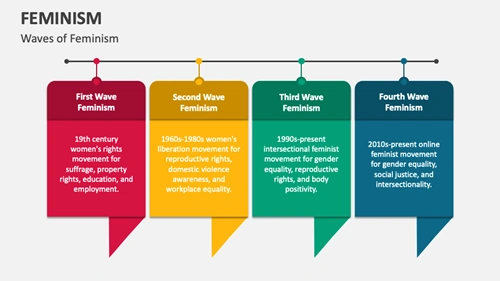
The First Wave: The Right to Simply Exist as a Citizen
The first wave of feminism, roughly spanning the mid-19th century to the early 20th
century, had one deceptively simple demand: let women be full citizens. This meant the
right to vote, the right to own property, and the right to receive an education. These
seem obvious to us now. At the time, they were considered outrageous.
In Britain, the suffragette movement reached its most dramatic pitch in the early 1900s.
Women chained themselves to the railings of 10 Downing Street. They smashed
windows on Oxford Street. They went on hunger strikes in prison and were force-fed by
the authorities - a outrageous spectacle that horrified the public and generated
enormous sympathy. The most iconic moment came in 1913, when Emily Wilding
Davison threw herself in front of the King's horse at the Epsom Derby and died four
days later. She had sewn suffragette colours into her coat. She knew exactly what she
was doing.
In America, the movement culminated in the 19th Amendment in 1920, granting women
the right to vote - though it is worth noting, with some discomfort, that this victory
applied mainly to white women. Black women in the American South faced poll taxes,
literacy tests, and outright violence at polling booths for decades more.
Meanwhile, in India, the colonial period produced its own remarkable reformers. Ram
Mohan Roy campaigned ferociously against sati and succeeded in getting it banned in
1829. Savitribai Phule - one of the most extraordinary figures in Indian history - opened
the first school for girls in Pune in 1848, at a time when her very presence in public
invited people to throw stones and dung at her. She carried a spare sari in her bag and
changed into it when she arrived at school. She did not stop. She did not slow down. She
taught.
By 1947, Indian women won something that many Western women waited far longer
for: universal suffrage at independence. India never had a separate suffragette struggle -
the vote was extended to all adults, men and women alike, from the very beginning of
the Republic. It was a quiet but remarkable achievement.
The Second Wave: The Personal Is Political
If the first wave asked for legal rights, the second wave - erupting in the 1960s and
1970s - asked something far more disruptive: it asked women to examine their own
lives. It declared that the kitchen, the bedroom, and the workplace were all political
spaces. The phrase that defined this era was coined by American activist Carol Hanisch:
The personal is political.
This wave was triggered, in part, by a book. Betty Friedan's The Feminine Mystique
(1963) gave voice to what she called the problem that has no name - the vague,
gnawing dissatisfaction of educated, middle-class women who had been told that
marriage and motherhood were their greatest fulfilments, and who found, upon
achieving both, that something essential was still missing.
The second wave tackled abortion rights, marital rape, domestic violence, workplace
discrimination, and the representation of women in politics and culture. In 1970,
women marched down Fifth Avenue in New York City in the Women's Strike for
Equality. In France, women left wreaths at the Tomb of the Unknown Soldier — with a
banner reading One unknown soldier more than the unknown soldier: his wife.
In India, the second wave arrived somewhat later and took distinctly Indian forms. The
1970s saw the rise of the anti-rape movement following the Mathura rape case (1972),
in which a young tribal girl was assaulted by two policemen who were subsequently
acquitted by the Supreme Court on the grounds that she had not raised an alarm. The
outrage that followed - with lawyers, academics, and activists writing open letters to the
Chief Justice - directly led to amendments in rape laws and the concept of custodial
rape.
The 1970s also saw the Chipko movement - women in the hills of Uttarakhand literally
hugging trees to prevent deforestation. It was simultaneously an environmental
movement and a feminist one: the women were protecting the forests because they
were the ones who collected firewood and fodder, the ones who suffered when the
forests disappeared. Their leader, Gaura Devi, had no formal education. She had
extraordinary clarity of purpose.
The Third Wave: Who Gets to Define 'Woman'?
By the 1990s, a new generation of women was growing up with rights their
grandmothers had fought for - and they were asking harder questions. The third wave
of feminism, beginning roughly in 1991, was born from a recognition that feminism had,
thus far, been largely the story of a particular kind of woman: educated, Western, and
white.
The third wave embraced intersectionality - a term coined by legal scholar Kimberlé
Crenshaw to describe how race, class, sexuality, disability, and gender overlap and
compound each other. A Black woman in America, Crenshaw argued, does not simply
experience racism plus sexism as two separate things - she experiences a specific,
unique form of discrimination that is neither simply racism nor simply sexism but
something altogether different.
The third wave was also more comfortable with contradiction. It embraced lipstick
alongside combat boots, pop music alongside political theory. It celebrated women who
were aggressive, sexual, and unapologetically ambitious. Pop culture was reclaimed
rather than rejected: the Spice Girls sang about Girl Power; Beyoncé declared herself a
feminist on a stadium screen.
In India, the third wave found expression in the Delhi gang rape case of 2012 - a
moment that cracked open a national conversation about women's safety, public space,
and the culture of silence around sexual violence. Hundreds of thousands poured into
the streets. The conversations that followed were uncomfortable, necessary, and long
overdue. Laws were amended. The conversation about consent entered public discourse
in an entirely new way.
The Fourth Wave: The Age of the Hashtag
The fourth wave of feminism is the one we are living in now, and its defining medium is
the internet. Beginning around 2012 and accelerating dramatically in 2017 with the
#MeToo movement, the fourth wave has used social media to do something
unprecedented: give individual women the ability to speak directly to millions, without
the permission of a newspaper editor, a television producer, or a publishing house.
When actress Alyssa Milano sent a tweet in October 2017 asking survivors of sexual
harassment to reply with Me Too, the phrase - originally coined by activist Tarana
Burke in 2006 for a very different context - became a global earthquake. Within 24
hours, the hashtag had been used more than half a million times. Within days, some of
the most powerful men in Hollywood, media, and politics had been exposed, resigned,
or been dismissed.
In India, #MeToo arrived in 2018 with a force that surprised many. Journalists,
comedians, actors, filmmakers, academics, and chefs were named. Some careers ended.
Many did not. The movement exposed how pervasive workplace harassment was in
industries that considered themselves progressive - and how rarely women had felt safe
to speak.
The fourth wave has also brought new debates into feminism - about trans inclusion,
about sex work, about reproductive rights in an age of renewed political attacks. These
debates are sometimes fierce, occasionally painful, and always necessary. A movement
that stops arguing with itself has probably stopped thinking.
What All of This Means for India
India occupies a unique and fascinating position in the global history of feminism. It is a
country where women have been worshipped as goddesses and treated as property
simultaneously. A country where a woman led the government as Prime Minister in
1966, yet where female foeticide remained common enough to distort the sex ratio in
several states. A country where the law guarantees equal rights and where the ground
reality, for many women, remains starkly different.
Indian feminism has never been a simple import from the West. It has its own ancient
roots - in the teachings of the Bhakti saints, in the philosophical tradition that revered
female scholars, in the extraordinary lives of women like Mirabai, Ahilyabai Holkar, and
Rani Lakshmibai. It has been shaped by the independence movement, by caste, by
religion, by class, by the enormous diversity of a country where women's experience
cannot be reduced to a single story.
What each wave of feminism has done - globally and in India - is expand the imagination
of what is possible. The right to vote. The right to say no. The right to name the harm
done to you. The right to be believed. These were not given freely. They were wrested,
argued, marched, and sometimes bled for.
The waves continue. They do not always move in a straight line. There are undertows
and reversals - governments that roll back women’s rights, courts that fail rape
survivors, workplaces that still pay women less for the same work. But the tide, on the
whole, has been moving in one direction. And it is not going back.