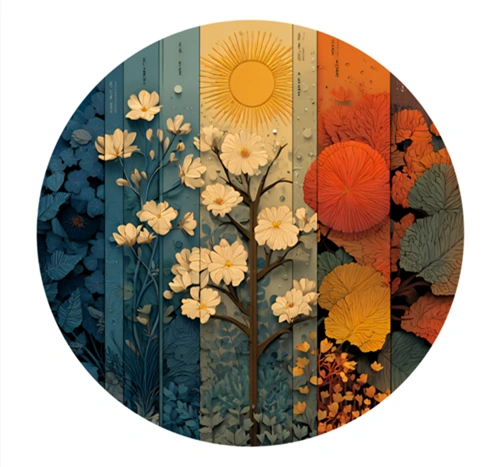
Human: I grow weary of change. Each season alters me, and I fear that nothing in me endures.
Nature: Tell me, what do you believe should endure?
H: My sense of self—the one I recognize. The one that feels coherent and whole.
N: And is that self the same in joy and in grief?
H: No. In joy I expand; in grief I contract.
N: Then which of these is the true self?
H: Perhaps neither entirely. Or perhaps both.
N: If both can be you, why must one exclude the other?
H: Because I long for permanence. Spring feels right—light, hopeful, unburdened. Why can I
not remain there?
N: What happens to a blossom that refuses to yield to fruit?
H: It withers.
N: Then is remaining in spring an act of preservation or of quiet destruction?
H: I see your point. Yet summer overwhelms me. Its demands are relentless. I feel exposed by
my own growth.
N: Is growth gentle?
H: No. It stretches, burns, and insists.
N: Then why do you ask life to grow without intensity?
H: Because intensity exhausts me.
N: And does exhaustion mean error, or merely participation?
H: Perhaps participation. Yet autumn troubles me most. Things fall away—relationships, roles,
certainties. I feel diminished.
N: When leaves fall, is the tree diminished?
H: No. It prepares for survival.
N: Then could loss be a form of preparation?
H: It could be. Still, winter feels like erasure. Silence replaces meaning. Who am I when
nothing moves?
N: When movement ceases, does existence cease?
H: No. It waits.
N: Then is waiting emptiness, or discipline?
H: Discipline—though it feels like abandonment.
N: Is it abandonment, or protection from premature growth?
H: I had not thought of it that way.
N: Tell me—do you wish life to end, or to continue?
H: To continue.
N: Then why resist the cycle that makes continuation possible?
H: Because falling feels like failure.
N: Does the fruit fail when it returns to the earth?
H: No. It completes its purpose.
N: Then might your falling be completion rather than defeat?
H: If that is so, then identity is not something I keep, but something I pass through.
N: Or something that ripens with each passage.
H: Then what is wisdom?
N: Not choosing a season, but allowing each to speak. Not clinging to form, but trusting
rhythm.
H: And what is a meaningful life?
N: One that blooms without fear, labours without resentment, releases without bitterness, and
rests without shame.
H: Then I am not broken because I change?
N: You would be broken if you did not.
H: I understand now—to become is not to lose myself, but to meet myself again and again.
N: And each meeting will be truer than the last.
The dialogue ends, but the lesson continues. We carry within us the four seasons—the
exuberance of spring, the intensity of summer, the letting go of autumn, the silence of winter.
Each has its place, each its purpose. To honour one is not to reject the others, but to recognize
that wholeness comes not from constancy but from completeness. We are not diminished by
our seasons; we are made whole by them. And in accepting this, we discover that identity is
not a fixed destination we must defend, but a living river we must trust—always moving,
always changing, always returning us to ourselves, renewed.