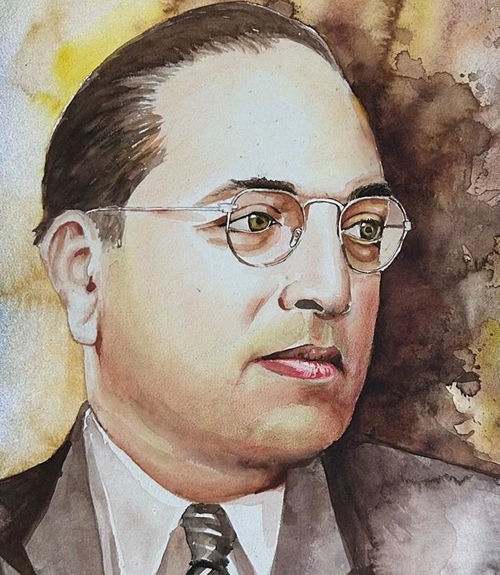
There is a story Dr Bhimrao Ramji Ambedkar carried all his life. As a child, he
and his siblings sat waiting at a railway station while the stationmaster refused
to let them ride in a cart driven by a caste Hindu. Their father was a soldier in the
British army. They had done nothing wrong. They were simply Mahar, an
untouchable caste; and that, in the social logic of the time, was crime enough.
Ambedkar never forgot the heat, the thirst, or the lesson: that no individual act of
decency would protect you if the system itself was built to exclude you.
That boy went on to become one of the most educated men of his era, holding
doctorates from Columbia University and the London School of Economics, fluent
in law, economics, history, and philosophy. He became the principal architect of
the Indian Constitution, the first Law Minister of independent India, and the
most formidable intellectual opponent that the caste system ever faced. And yet,
even in old age, he would say with characteristic bluntness: I measure the
progress of a community by the degree of progress which women have
achieved.
Ambedkar and Caste
To understand Ambedkar, you must understand what caste actually is, not in the
soft sociological sense of social stratification, but in the brutal lived sense he
described. Caste is not merely inequality. Poverty can be overcome;
discrimination can be challenged in court; prejudice can, in principle, be
educated away. Caste, Ambedkar argued, is something more durable and more
vicious: it is a graded hierarchy in which every group is simultaneously
oppressor and oppressed, with the Brahmin at the top and the untouchable at
the very bottom; not merely poor, not merely discriminated against, but ritually
polluted, physically segregated, and spiritually condemned.
Ambedkar wrote in Annihilation of Caste, “Caste is not a physical object like a
wall of bricks or a line of barbed wire which prevents the Hindus from co-
mingling and which has, therefore, to be pulled down. Caste is a notion; it is a
state of the mind. This distinction, between caste as a structure and caste as a
state of mind, is the key to everything Ambedkar wrote. It explains why he was
so impatient with reformers, so contemptuous of Gandhi's Harijan project, so
uncompromising in his demand for annihilation rather than reform. You cannot
fix an unjust system by making it kinder; you have to uproot it. Ambedkar never
asked to be included in a system he had already diagnosed as the disease itself.
In 2014, Arundhati Roy wrote a long, controversial introduction to a new edition
of Ambedkar's 1936 speech-turned-essay, Annihilation of Caste. The speech was
one that Ambedkar had prepared for a Hindu reform conference that then
disinvited him, because he had sent the text in advance and its radicalism
alarmed the very people who claimed to want reform. He published it himself. It
became a classic that was, for decades, quietly buried.
Roy's introduction, titled, The Doctor and the Saint, referring to Ambedkar and
Gandhi, is itself a work of historical excavation. She traces how Gandhi and
Ambedkar came to represent two completely different ideas of India: Gandhi, the
nationalist who believed the spiritual renovation of Hinduism could cure caste
while keeping the social order intact; Ambedkar, the constitutionalist who
believed the only honest path was demolition. Gandhi wanted untouchables
brought into the fold. Ambedkar wanted the fold itself examined, and done away
with. Roy argues, persuasively, that Indian public life has chosen Gandhi's
comfort over Ambedkar's clarity, and that we are living with the consequences.
Rights, not Charity
Ambedkar was not simply a social reformer. He was a systematic political
thinker, and his thought had clarity. At its foundation was a deep suspicion of
majoritarianism, the idea that democracy means whatever the majority decides.
A democracy in which the majority belongs to a single dominant social group, he
argued, is not democracy at all: it is tyranny with a ballot box. This is why he
fought for reserved constituencies, for separate electorates, for proportional
representation, not as concessions to injured pride, but as structural guarantees
against the permanent exclusion of minorities from political power.
His drafting of the Indian Constitution was the fullest expression of this
philosophy. The document he produced, often called the most ambitious attempt
at social transformation through law in any country's founding text, guaranteed
equality before the law, prohibited discrimination on grounds of religion, caste,
sex or place of birth, and abolished untouchability entirely. It was, in the words
of scholar Pratap Bhanu Mehta, a constitution written in defiance of Indian
society. Ambedkar knew it. He also knew its limits. Constitutional morality is
not a natural sentiment. It has to be cultivated.
Ambedkar was a man of extraordinary intellectual courage, who spent his life
fighting a system that had tried, from the moment of his birth, to convince him
that his subordination was the will of god. He refused the consolation. He built
institutions to carry it forward after him. In a country still struggling with the
distance between its constitutional promises and its daily social reality, that
refusal, that insistence, remains the most necessary inheritance he left us.
Ambedkar’s conversion to Buddhism was a philosophical statement: that you
cannot annihilate caste while remaining within the religious framework that
sanctifies it. He said a country that practiced untouchability was not, in any
meaningful sense, a civilisation.
India has, in recent decades, made a kind of peace with Ambedkar, a peace of
statues and currency notes and renamed universities. His face appears on walls
across the country. His birthday is a national holiday. And yet the substance of
what he said remains, in mainstream Indian discourse, quietly avoided.
Ambedkar is someone who understood that the most durable forms of injustice
are the ones that their victims have been persuaded to call natural, even divine.