"I regard the theatre as the greatest of all art forms, the most immediate way in which a
human being can share with another the sense of what it is to be a human being." - Oscar
Wilde
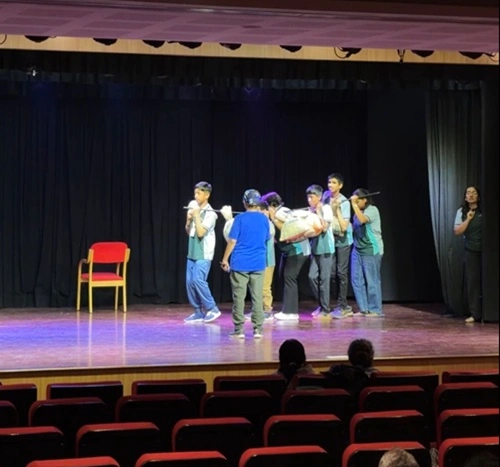
The lights went down. A hush fell over the auditorium. And then, one by one, they
walked out: thirty-three children, some nervous, some beaming, all of them ready. What
followed was an hour of theatre that was equal parts joyful, bold, and quietly
extraordinary. Anantha Academy for Special Education, Bengaluru, presented Alibaba,
their first-ever theatrical extravaganza.
A Stage Built on Belief
Anantha Academy for Special Education operates on a single conviction: every child's
potential is real, and deserves to be recognized, nurtured, and catered to. Supporting
students above the age of six across a wide range of disabilities, the Academy offers
NIOS coaching, prevocational and vocational training, and programs shaped around
everyone. Their motto, Infinite Possibilities, is not a tagline. It is a daily practice.
This practice extends well beyond the classroom. The Academy understands that
children with diverse needs require more than academic accommodation; they require
spaces where their whole selves are welcome, where expression, movement, and
creativity are treated as essential, not supplementary. Their self-sustaining model,
responsive to individual goals, is precisely this kind of space. This theatrical production
was not a footnote in their calendar. It was evidence of a philosophy in action.
The Woman Behind the Curtain
Diana Thaloor, a movement, dance, and drama therapist with 27 years of experience,
directed the play and drew out what lived quietly inside her students. Ms. Thaloor's
approach to theatre is not about polish or perfection. It is about process of what
happens to a child in the months between the first rehearsal and the final bow. Working
with a cast of thirty- three, she built not just a production, but a shared world.
Rehearsals began in August. In the early weeks, the children were reluctant. Waiting for
cues felt abstract. Delivering dialogue on command felt strange. The stage, for many,
was unfamiliar territory and unfamiliarity, for children with sensory sensitivities and
diverse learning needs, can feel enormous. For children on the autism spectrum, the
challenges were layered: the brightness of stage lights, the weight and texture of
costumes, the sudden swell of music and sound. These were not small things to
navigate.
They navigated every challenge, and week by week they grew familiar with the
unfamiliar, learned their cues, delivered their lines with confidence, and wore their
costumes with pride. What began as reluctance slowly, steadily, transformed into
something that looked a great deal like ownership.
From Classroom to Stage
There is a particular kind of learning that only becomes visible when it is performed. In
a classroom, a child might follow instructions, respond to prompts, and practice a skill
in a controlled setting. Theatre demands more; it asks children to refine learning into
expression. To move with intention. To listen, truly listen, to the person beside them. To
hold a moment, and then let it go.
This shift from in-class activity to full production is where the real growth happens.
Research supports what teachers and therapists have long observed: theatre,
movement, and music create pathways for development that other interventions cannot
always reach. Inclusive theatre programs provide children the opportunity to practice
eye contact, turn-taking, active listening, teamwork, and appropriate body language, not
as exercises, but as lived, joyful experience. For children with special needs, the stage
becomes not just a platform but a practice ground for life.
Stepping into the Spotlight
This production invited each child to step forward, claim space, and inhabit the role of
the main character, encouraging performers to embrace visibility and engage fully with
the moment rather than remain on the sidelines, while rehearsals gradually replaced
hesitation with familiarity and strengthened confidence through practice and shared
effort.
As the cast took their final bow and applause filled the auditorium, the thirty-three faces
on stage reflected discovery and accomplishment, revealing performers who recognized
their own growth, trusted their preparation, and carried pride in what they had
achieved, a confidence that travelled beyond the stage into classrooms, homes, and
everyday moments where it continued to take shape.
Even after the applause faded, the courage to stand in the light endured and continued
to guide them forward.